With billions of taxpayers’ money lost through inflated and overpriced government contracts, Malawi should perhaps not be surprised when some of that wealth finds its way back to the public in the form of donations.
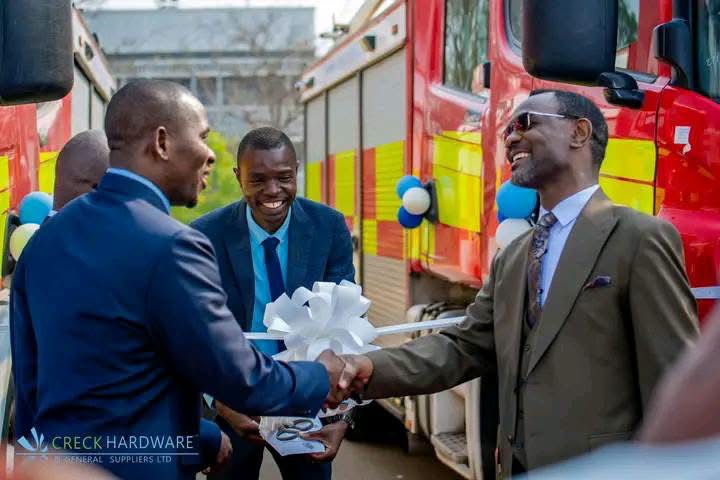
Creck Hardware and General Suppliers has donated two firefighting and emergency response vehicles worth approximately K300 million to the Ministry of Local Government.
The trucks, handed over by the company’s Managing Director, Apostle Clifford Kawinga, at Capital Hill in Lilongwe, have been allocated to Mangochi Municipal Council and Lilongwe City Council.
The donation has been presented as a significant contribution towards national safety, community development and strengthening Malawi’s emergency response capacity under the administration of Professor Arthur Peter Mutharika.
And yes, Malawians should welcome equipment that can save lives and protect property.
But we must also ask a difficult question:
Where did the money come from?
Creck Hardware is not an ordinary charitable organisation. It is a major supplier to government institutions and has, over the years, been associated with several high-value public procurement deals.
Its own company profile confirms that government is among its target markets.
Public procurement records have also shown Creck Hardware winning government supply opportunities, including a 2024–2025 framework agreement with Blantyre Water Board for the supply of GI pipes, fittings and accessories.
The company has also been at the centre of public scrutiny over major procurement transactions.
In 2024, reports indicated that Creck Hardware had been linked to transformer supply contracts worth about K5.9 billion, while another reported government procurement involved approximately K300 million for breathalysers and speed cameras.
More recently, the company was again drawn into controversy over a proposed K12.24 billion ESCOM transformer contract. The procurement had reportedly received a no-objection from the Public Procurement and Disposal of Assets Authority, but the matter was later escalated to the Office of the President and Cabinet and the proposed deal did not proceed. ESCOM has stated that the procurement processes remained active and that no contract award had been concluded.
There have also been past questions surrounding contracts awarded to the company, including the Likoma and Chizumulu power generator project.
At the time, Kawinga strongly denied allegations of political favouritism and maintained that Creck Hardware had won its contracts through proper procedures.
However, the broader question of value for taxpayers’ money remains legitimate.
This is where the public must not be blinded by donations.
When companies make enormous profits from government contracts, particularly in an environment where Malawians are repeatedly confronted with allegations of inflated procurement prices, politically connected suppliers and questionable value for money, a donation can easily become a public relations exercise.
Robin Hood, according to the popular legend, stole from the rich and gave to the poor.
But the question Malawians should ask is whether we are witnessing a different version of that story:
Taxpayers’ money enters through government contracts, private fortunes are created, and later a fraction of that money returns to the public as a donation accompanied by applause.
Should we clap?
Of course, the two firefighting vehicles are welcome.
A functioning fire engine can save a family, a business, a hospital, a market and countless lives. Mangochi and Lilongwe need improved emergency response capacity.
But Malawians should not be reduced to celebrating the return of a small portion of money that may have originally come from public expenditure, while remaining silent about whether every kwacha paid under government contracts represented genuine value for money.
A K300 million donation should not close the conversation about billions of kwacha in public procurement.
Charity does not replace accountability.
Corporate generosity does not erase legitimate questions about procurement.
And a donation to government should never become a substitute for transparent investigations into allegations of inflated prices, conflict of interest, political influence or abuse of public funds.
So yes, let us appreciate the firefighting trucks.
Let us appreciate any contribution that protects lives and property.
But let us also remember:
What belongs to Malawians must genuinely benefit Malawians not first disappear through questionable contracts and then return in the form of charity.
The trucks may be a good deed.
But accountability for taxpayers’ money is an even greater national duty.
About the Author