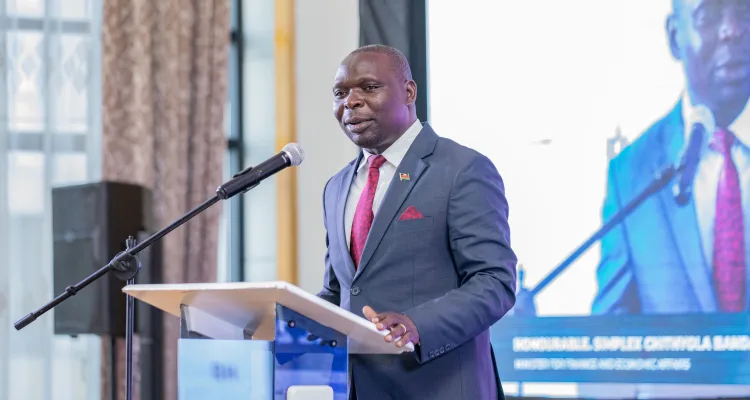
Leader of Opposition in Parliament, Simplex Chithyola Banda, has launched a scathing attack on the Democratic Progressive Party (DPP) government, accusing it of abandoning Malawians in times of crisis, fueling divisions among citizens, undermining constitutional institutions, and driving the country deeper into economic hardship.
In a strong statement released today, Banda said the DPP administration has demonstrated a disturbing pattern of negligence, incompetence, and misplaced priorities while ordinary Malawians continue to suffer.
At the center of his criticism was the government’s sluggish and ineffective response to the plight of thousands of stranded Malawians in South Africa.
“These are not strangers. They are Malawians. They are our brothers and sisters,” Banda said. “Yet the government has responded with silence, delays, and excuses while vulnerable citizens remain trapped in uncertainty. A responsible government would have moved swiftly to coordinate their safety, welfare, and repatriation. Instead, the DPP administration has chosen complacency.”
He said the government’s failure to act decisively reflects a leadership that has lost touch with the struggles of its own people.
“When a government cannot protect its citizens beyond our borders, it raises serious questions about its commitment to those within our borders as well.”
Banda also condemned remarks attributed to Minister of Foreign Affairs Dr. George Chaponda regarding Malawians of Ngoni origin, describing them as reckless, divisive, and unacceptable.
“No Malawian should ever be made to feel like a foreigner in their own country,” he said. “The Ngoni people are an integral part of Malawi’s history, culture, and development. Any attempt to question their belonging is not only offensive but dangerous. Leaders should be promoting national unity, not sowing seeds of division.”
According to Banda, while Malawians abroad are crying out for diplomatic protection and support, senior government officials appear preoccupied with divisive rhetoric that undermines national cohesion.
He further accused the DPP government of deliberately weakening key democratic institutions for political convenience.
Referring to recent events surrounding the commemoration of the late Vice President Dr. Saulos Klaus Chilima, Banda emphasized that the Office of the Vice President is protected by the Constitution and must not be treated as a political accessory.
“The Vice Presidency is not a gift from the President. It is a constitutional office that deserves respect and protection. What we are witnessing is a systematic erosion of institutions that should serve all Malawians, not the interests of a few individuals.”
He warned that Parliament, law enforcement agencies, and oversight institutions are increasingly being manipulated for partisan purposes, a trend he said threatens the foundations of democracy.
“A government confident in its performance does not fear scrutiny. It does not weaponize institutions against critics. It respects the rule of law and allows accountability to flourish.”
Banda also took aim at what he described as growing nepotism and patronage within government appointments.
“Public offices do not belong to politicians. They belong to the people of Malawi. Yet we continue to see appointments that reward loyalty rather than competence. This culture of patronage is undermining public confidence and depriving the nation of capable leadership.”
However, it was the worsening economic crisis that drew his strongest criticism.
He accused the DPP government of presiding over a collapsing economy while failing to provide meaningful solutions to the challenges confronting ordinary citizens.
“Malawians are being crushed by the rising cost of living. Families cannot afford basic necessities. Businesses are struggling to access foreign exchange. Farmers are working tirelessly but earning little in return. Young people are graduating into unemployment and hopelessness.”
Banda said soaring food prices, persistent fuel challenges, shortages of foreign currency, and declining public services are clear evidence of a government that has lost control of the economy.
“Instead of addressing the real problems facing citizens, this government continues to spend public resources on questionable priorities while hospitals lack essential medicines, schools remain underfunded, and agricultural support continues to deteriorate.”
He argued that the suffering experienced by millions of Malawians is not the result of bad luck but the direct consequence of poor leadership, weak governance, and a failure to prioritize the needs of the people.
Despite his criticism, Banda said the opposition remains committed to supporting any initiative that genuinely serves the national interest.
“Where government acts responsibly and in the best interests of the people, we will support it. But where government fails, neglects, or betrays the trust of Malawians, we will continue to speak out boldly and without fear.”
He concluded by warning that Malawi stands at a critical crossroads.
“Our nation cannot continue on a path marked by economic hardship, institutional decay, division, and declining public confidence. Malawians deserve leadership that listens, leadership that delivers, and leadership that puts the people first. The time for excuses is over. The time for accountability is now.”
About the Author