Screenshot
Zimbabwe’s confirmation of an Interpol Red Notice for a woman accused of stealing a luxury vehicle has reignited scrutiny of a contentious Malawi High Court ruling that left a prominent businessman in possession of the disputed SUV.
Cables can confidently reveal .
Zimbabwe’s official confirmation of an Interpol Red Notice for a woman accused of orchestrating a high-stakes cross-border vehicle heist has thrown sharp, unforgiving light back onto a deeply contentious Malawian High Court ruling.
The dramatic international escalation intensifies a bitter legal battle between Zimbabwean car-rental owner Nesbert Mukora and prominent Malawian businessman Yollam Kawanga, exposing profound structural and procedural questions about how domestic courts handle transnational property disputes.
At the heart of the controversy is a luxury Toyota Land Cruiser 300 VX, valued at approximately USD 150,000 (K300 million), which vanished from Harare in April 2025 and was subsequently swallowed by a sophisticated smuggling syndicate operating across South Africa, Mozambique, and Malawi.
On June 18, 2026, High Court judge Justice Simeon Mdeza rejected an application by Mukora to stay execution in civil proceedings over the vehicle, which had already been handed over to Kawanga after he maintained he purchased it in good faith for K168 million.
While the practical effect of the judgment left Kawanga in possession of the SUV, its underlying legal reasoning rests on extraordinarily shaky ground. By treating domestic administrative clearances as an absolute shield against credible evidence that a vehicle was stolen abroad using fraudulent paperwork, the court created a potentially dangerous legal precedent.
Now, with the primary suspect reportedly flagged internationally, the judgment’s foundational reasoning faces renewed scrutiny.
THE RED NOTICE: INTERNATIONAL CASE TAKES A DRAMATIC TURN
The international dimensions of the alleged crime have now been formalised through official law enforcement channels.
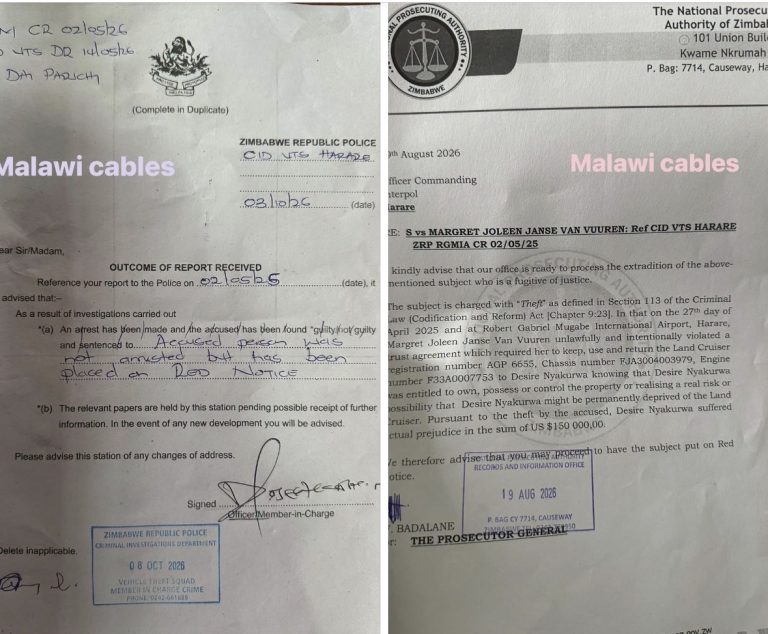
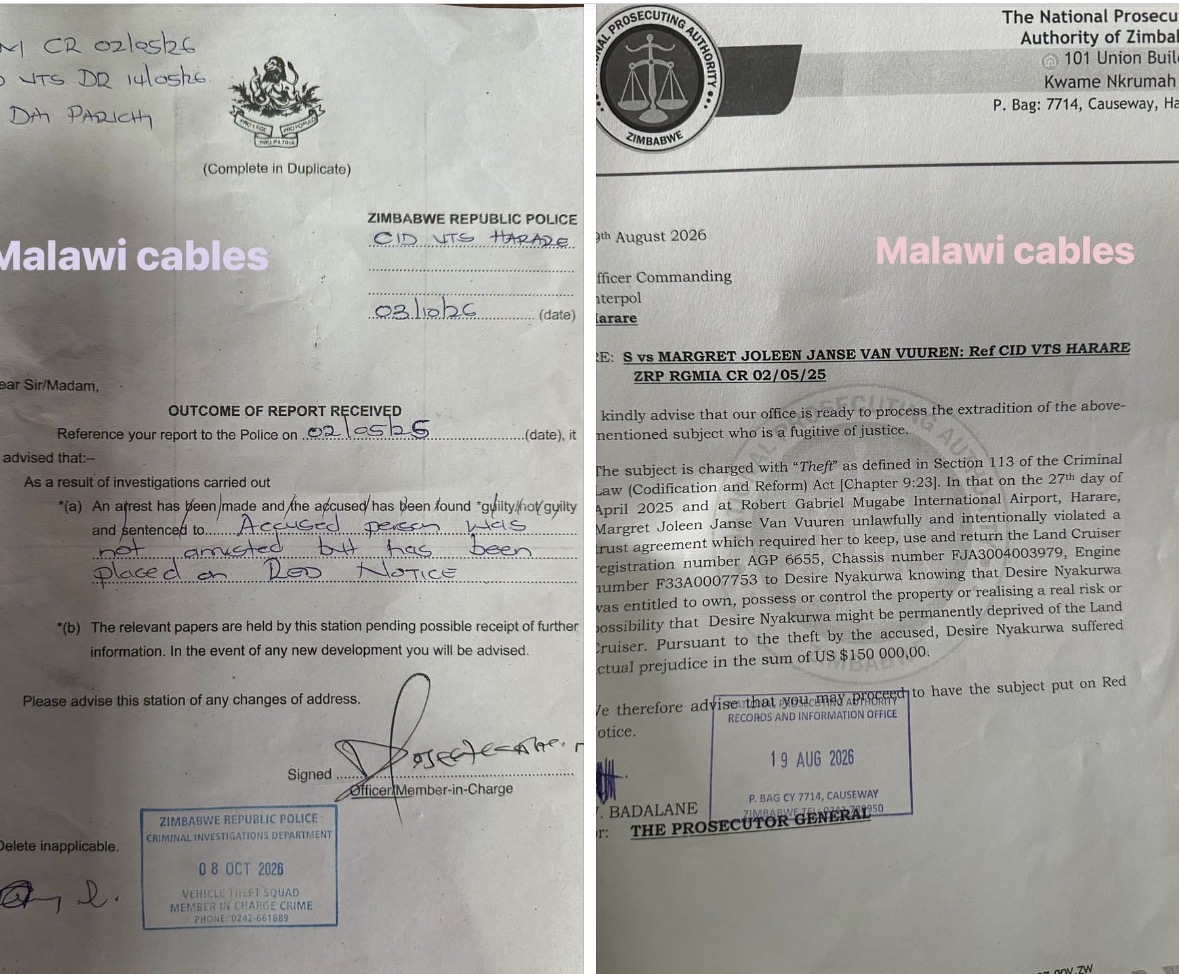
In correspondence dated August 19, 2026, Zimbabwe’s Prosecutor General’s Office formally requested that Interpol Harare proceed with placing Margret Joleen Janse Van Vuuren on a Red Notice to facilitate her extradition. Subsequent police confirmation records verify that the international alert was successfully secured.
The case, catalogued under S v Margret Joleen Janse Van Vuuren (Ref: CID VTS HARARE ZRP RGMIA CR 02/05/25), details charges of theft under Section 113 of Zimbabwe’s Criminal Law (Codification and Reform) Act [Chapter 9:23].
According to prosecution documents, the alleged offence occurred on April 27, 2025, at Robert Gabriel Mugabe International Airport in Harare. Van Vuuren allegedly breached a trust agreement under which she was entrusted with the Land Cruiser, bearing registration number AGP 6655, chassis number FJA3004003979, and engine number F33A0007753, which she was required to keep, use, and return.
An official update from the Zimbabwe Republic Police CID Vehicle Theft Squad, dated October 8, 2026, confirmed: “Accused person was not arrested but has been placed on RED NOTICE.”
An Interpol Red Notice is a request to law enforcement agencies worldwide to locate and provisionally arrest a person pending extradition, surrender, or similar legal action. It is not an international arrest warrant or a final determination of guilt.
Nevertheless, the development raises fresh questions about the circumstances surrounding the vehicle’s disappearance and how it allegedly crossed regional borders.
ADMINISTRATIVE CLEARANCE VERSUS LEGAL OWNERSHIP
The central controversy surrounding the Malawi High Court proceedings lies in the weight placed on domestic paperwork.
Kawanga’s defence relied heavily on a Temporary Importation Permit (TIP) issued by the Malawi Revenue Authority and a police clearance certificate from the Malawi Police Service.
However, previous investigations by the Platform for Investigative Journalism reportedly revealed crucial findings by South African police: that the entry documents used to bring the vehicle into Malawi were fraudulent and that the SUV had been officially reported stolen. Foreign nationals also faced separate criminal proceedings in Malawi connected to the alleged smuggling operation.
Under Section 23 of Malawi’s Sale of Goods Act, the legal principle nemo dat quod non habet generally means that a person cannot transfer a better title to property than they themselves possess, subject to applicable legal exceptions.
The controversy therefore raises a fundamental question: should administrative clearance be treated as sufficient proof of ownership when credible evidence suggests that a vehicle may have been stolen abroad?
Critics argue that courts must carefully distinguish between evidence that a vehicle passed through administrative procedures and evidence establishing valid legal title.
They further contend that requiring a foreign owner to pursue compensation from the State, rather than recover disputed property, could shift the consequences of alleged administrative failures onto the very person seeking justice.
THE WHATSAPP TRAP: QUESTIONS OVER DUE PROCESS
Procedural due process was similarly contested throughout the litigation.
Mukora’s legal team argued that their client had never been properly served and remained unaware of the civil proceedings that resulted in the vehicle being awarded to Kawanga.
According to their account, the court had authorised substituted service via WhatsApp, but the targeted phone number allegedly belonged to a sales representative, Desire Nyarukwa, rather than Mukora himself.
To support this argument, Mukora’s lawyers obtained a copy of Nyarukwa’s passport to demonstrate that the person associated with the phone number was not the defendant.
Mukora’s legal team maintained that the court should have demanded strict compliance with the rules governing service, including the principles they associated with Malawi Communications Regulatory Authority v Jonathan Pinifolo.
However, they contend that the court instead relied on what they describe as circular reasoning, treating Mukora’s ability to access his employee’s passport as evidence of an “affinity” with the phone number.
The dispute raises questions about whether the evidence sufficiently established that Mukora had been properly notified of proceedings that ultimately affected his claim to the vehicle.
A DANGEROUS PRECEDENT? EXECUTION AND THE QUESTION OF REMEDIES
Justice Mdeza’s conclusion that “there is nothing to stay” because execution had already been completed has also drawn criticism.
Critics argue that the physical handover of a disputed asset should not, by itself, prevent meaningful scrutiny of whether the underlying legal process was properly conducted.
The judgment’s reported reliance on Kawanga’s substantial wealth as reassurance that he could compensate Mukora if a future trial proved him wrong has likewise raised concerns.
A unique luxury vehicle, with its own registration, history, and potential evidential significance, cannot always be treated as interchangeable with a future cash payment. Cross-border claimants may also encounter considerable practical obstacles when seeking to enforce judgments in another jurisdiction.
The central question is whether monetary compensation would adequately address the loss if the claimant ultimately established a superior legal right to the vehicle.
LAWYER DELIVERS SCATHING CRITICISM OF THE RULING
A prominent Malawian lawyer, who opted for anonymity, delivered a scathing criticism of Justice Mdeza’s judgment, challenging what he described as its nationalistic framing and questionable legal reasoning.
The lawyer focused on the judge’s reported declaration that:
“The law will become useless if it fails to protect Malawian victims of such fraudulent devices, who end up losing the hard-earned cash… to those rogues.”
“This ruling is a catastrophic embarrassment to judicial logic,” he stated. “It is an egregious distortion of justice to frame a commercial property dispute as a chauvinistic crusade between ‘Malawian victims’ and foreign ‘rogues’ before the actual facts are even adjudicated. Nationality does not launder stolen property, and being a local buyer does not magically cure a fraudulent chain of custody.”
The lawyer warned that, in his view, placing national protection above rigorous examination of the evidence could create a dangerous loophole for cross-border criminal networks.
“This judgment sends a chilling, corrupt signal to transnational crime syndicates,” he added. “It tells car-smuggling rings across SADC that if you can slip a stolen luxury car across the border and sell it to a well-connected local buyer, our courts will bend over backwards to protect the spoils. It subordinates the rule of law to administrative convenience, leaving regional property rights dangerously exposed.”
THE BIGGER QUESTION: CAN PAPERWORK OVERRIDE PROPERTY RIGHTS?
The emerging international dimension of the Land Cruiser dispute places renewed focus on the relationship between administrative clearance, lawful ownership, procedural fairness, and cross-border cooperation.
The confirmation of a Red Notice does not establish the guilt of the accused woman, nor does it automatically determine ownership of the disputed vehicle. Equally, possession of administrative documents does not, on its own, resolve every question about the legality of a vehicle’s ownership history.
The critical issues remain whether the vehicle was stolen, whether the relevant documents were authentic, whether Kawanga acquired valid legal title, and whether Mukora was afforded a fair opportunity to present his case.
As the international investigation develops, Justice Mdeza’s ruling is likely to remain at the centre of debate over how Malawi’s courts should balance the protection of local purchasers with the rights of foreign claimants in complex cross-border property disputes.
About the Author