Screenshot
For controversial Malawian businessman Abdul Karim Batatawala, the questions are no longer confined to his dealings in Malawi.
They are increasingly crossing borders.With revelations that ANARCO INTERNATIONAL LTD registered under number 11837821 which belongs to his wife is under investigation in United Kingdom. Only cables can confidently reveal .
Documents and information reviewed by cables indicate that Batatawala, his wife Sabina Abdul Batatawala, and a network of companies associated with them are attracting scrutiny in both Malawi and the United Kingdom amid questions surrounding company ownership, movement of foreign currency, tax obligations, immigration matters and the continued operation of businesses allegedly linked to entities that have previously faced restrictions or regulatory action in Malawi.
At the centre of the emerging picture is a simple but uncomfortable question:
How does a businessman whose business empire has repeatedly come under the scrutiny of Malawian authorities continue to operate through companies associated with family members and other entities while billions of kwacha in alleged tax liabilities and other obligations remain unresolved?
The answer may lie partly in the structure of the business network itself.
THE UK COMPANY REGISTERED IN SABINA’S NAME
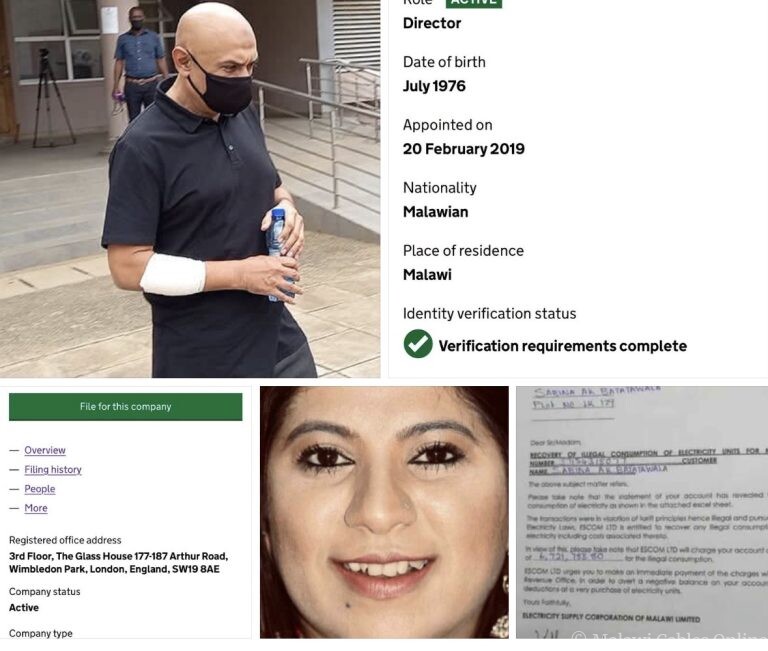
Records reviewed by cables show that a United Kingdom-registered company, ANARCO INTERNATIONAL LTD, is associated with Sabina Abdul Batatawala.
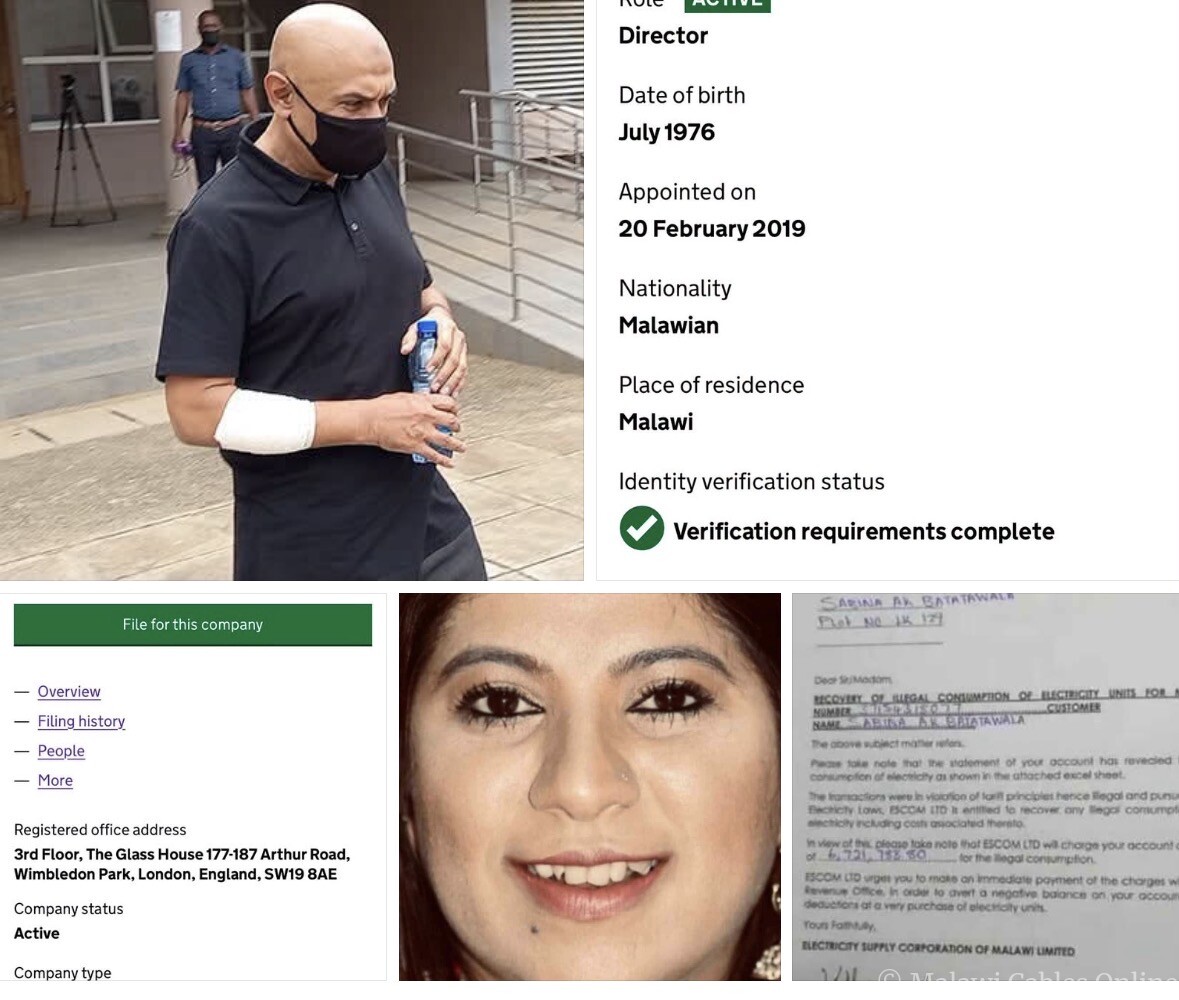
According to the information available to cables , Sabina is listed as the company’s director and the company is registered at address 3rd Floor, The Glass House 177-187 Arthur Road, Wimbledon Park, London, England, SW19 8AE.
The company Nature of business (SIC) is indexed 68320 which belongs to Management of real estate on a fee or contract basis category. A good cover for money laundering and it was incorporated on 20 February 2019.
The significance of the company is not simply that it exists.
It is the questions surrounding its alleged role within the wider Batatawala business network.
Sources familiar with the matter allege that the UK company has been used in connection with business transactions involving substantial amounts of foreign currency.
Those allegations are now reportedly attracting the attention of investigators in the United Kingdom, where questions have allegedly been raised about the source and purpose of funds moving through the company and whether there is sufficient underlying commercial activity to explain the transactions.
UK authorities have not concluded that ANARCO INTERNATIONAL LTD has committed any offence.
That distinction is important.
But the reported scrutiny raises legitimate questions about the relationship between the UK company, Sabina Batatawala and the wider network of businesses associated with her husband.
THE PROXY COMPANY QUESTION
For years, Batatawala has been associated with a number of companies operating in Malawi.
Some of these entities have featured prominently in government procurement, commercial disputes, tax matters and investigations.
Among them are companies such as Universal Kit Supplies, African Commercial Agency and Kasco Enterprise, as well as other entities linked to the broader network.
The concern raised by investigators and other sources is whether companies registered in different names have, in practice, operated as part of a common commercial network.
Although businesses are perfectly entitled to establish subsidiaries, related companies or separate commercial entities, the problem arises when corporate structures are allegedly used to circumvent regulatory restrictions, conceal beneficial ownership, avoid liabilities or continue business through another entity after a related company has been subjected to sanctions or restrictions.
That is precisely the question that deserves proper investigation.
SABINA’S OWN HISTORY WITH THE AUTHORITIES
The involvement of Sabina in the Batatawala business story is not entirely new.
In May 2022, the Electricity Supply Corporation of Malawi (ESCOM) raised an alleged illegal electricity connection associated with an account in Sabina’s name.
Correspondence from ESCOM reviewed by this publication indicated that the utility company had identified what it described as an illegal connection under meter number: 37154318077, and demanded payment of approximately K6.7 million.
The correspondence warned that the transactions constituted a violation of tariff principles and that ESCOM was entitled under the applicable electricity laws to recover the value of electricity allegedly consumed illegally and associated costs.
The episode is important not because an electricity dispute proves wrongdoing in the wider business empire, but because it demonstrates that Sabina herself has previously featured in regulatory correspondence concerning business-related matters.
Now her name appears again in connection with a UK-registered company that is reportedly attracting scrutiny over foreign-currency transactions.
That deserves answers.
BILLIONS IN TAX LIABILITIES
Perhaps the most disturbing aspect of the Batatawala story, however, is the sheer scale of the financial disputes involving his companies and the apparent difficulty authorities have had in bringing some of these matters to final resolution.
Information available to cables indicates that Batatawala-linked businesses have faced substantial claims and penalties from the Malawi Revenue Authority (MRA).
Among the figures cited in connection with the businessman is an alleged K17 billion tax liability and/or penalties which, according to information available to us, remains substantially unresolved.
If that figure is accurate, it raises an obvious public-interest question:
Why is the Malawi Revenue Authority unable to recover money of this magnitude from a businessman whose companies continue to operate and participate in commercial activity?
Malawi is currently facing severe fiscal pressure.
Hospitals struggle for medicines. Public institutions face financing constraints. Government departments are forced to operate under increasingly tight budgets.
Yet billions of kwacha in alleged tax liabilities can remain locked in disputes for years.
That is not merely a Batatawala problem.
It is a question about the effectiveness of the enforcement machinery of the Malawi state.
THE BILLIONS AT THE CENTRE OF THE BATATAWALA NETWORK
The scale of the money involved is difficult to ignore. Based on court records, government documents, tax records and information reviewed by this publication, transactions and claims involving companies associated with Batatawala run into tens of billions of kwacha, with some individual transactions raising particularly serious questions.
These include the approximately K12 billion Immigration uniform and accessories contract associated with Universal Kit Supplies and related companies; an alleged K17 billion in outstanding MRA tax liabilities and penalties; the approximately K4.7 billion claim arising from litigation involving Universal Kit Supplies; and the historical K1.475 billion payment reportedly made in circumstances where the actual value of the goods was said to be around US$250,000.
There are also allegations involving substantial foreign-currency transactions, externalisation of forex and payments running into millions of United States dollars, with the full cumulative value yet to be established.
Among the figures that have emerged from the various transactions and claims are the approximately US$9.4 million equivalent represented by the historical K1.475 billion payment at the then prevailing exchange rate, against goods whose actual value was reportedly around US$250,000; the approximately US$30 million claim reportedly advanced by Batatawala and/or companies associated with him in separate commercial disputes; and other alleged foreign-currency transactions whose values investigators are still understood to be examining.
These figures must be treated in the context of the underlying contracts, court proceedings and financial records rather than automatically characterised as losses or illicit proceeds. Nevertheless, taken together with the K17 billion in reported MRA liabilities, the K12 billion Immigration contract, and the approximately K4.7 billion court claim involving Universal Kit Supplies, they point to a business network around which tens of billions of kwacha and millions of US dollars have passed, been claimed, or become the subject of disputes and investigations.
UNIVERSAL KIT AND THE BILLION-DOLLAR QUESTION
Another chapter of the Batatawala story involves Universal Kit Supplies, a company associated with him that has featured in major government procurement and legal disputes.
The company has been involved in litigation concerning payments allegedly owed by government.
Court and government records reviewed by this publication indicate that the disputes have involved extraordinary sums.
At one point, figures running into billions of kwacha were at the centre of the litigation.
There are also questions surrounding a payment of approximately K1.475 billion reportedly made in connection with goods whose stated value was substantially lower.
The historical transaction has raised questions about the circumstances in which the payment was made, the valuation of the goods and subsequent efforts to recover public money.
These matters should ultimately be determined through documentary evidence and court processes—not speculation.
But they form part of a much bigger pattern that authorities cannot afford to ignore.
THE IMMIGRATION CONNECTION
Batatawala’s companies have also featured prominently in disputes involving the Department of Immigration and Citizenship Services.
Companies associated with him have been involved in major government contracts, including contracts relating to uniforms and other supplies.
Some of those transactions subsequently attracted the attention of law-enforcement and anti-corruption authorities.
The important question now is whether the various investigations and court proceedings involving Batatawala and companies associated with him have been brought to their logical conclusion.
If they have, where are the final outcomes?
If they have not, why not?
And if companies have been restricted or debarred, how are related businesses continuing to operate?
THE FOREIGN-CURRENCY QUESTION
Perhaps the most important emerging issue is foreign currency.
Malawi has spent years battling acute shortages of foreign exchange.
Businesses have struggled to access United States dollars and other hard currencies.
The Reserve Bank and other authorities have repeatedly warned against illegal externalisation of foreign exchange.
It is against that background that allegations concerning large foreign-currency transactions involving entities connected to Batatawala and his wife become particularly significant.
Sources familiar with the investigations allege that substantial amounts of foreign currency have moved through the network without a sufficiently clear underlying commercial explanation.
Those allegations require proper investigation.
They should not be dismissed simply because the companies involved are registered abroad.
Nor should registration in the name of a spouse or relative automatically place transactions beyond the reach of investigators.
The real issue is beneficial ownership, source of funds and purpose of transactions.
THE DUBAI PROPERTY TRAIL.
Our investigation has also uncovered information pointing to property interests associated with the Batatawala family in Dubai.
Sources allege that the family holds residential and commercial properties in different parts of the United Arab Emirates.
The allegations go further, suggesting that some of the assets may have been acquired using funds whose origins require further examination.
Given the wider allegations concerning foreign exchange and financial transactions, the Dubai property question deserves attention from investigators.
A FAMILY BUSINESS OR A CORPORATE NETWORK?
This is where the story becomes more complicated.
Batatawala is not simply a businessman operating one company.
He has been associated with a network of companies, some directly connected to him and others registered in the names of associates or family members.
That raises a fundamental question for regulators:
Who ultimately controls these companies?
Corporate registration is one thing.
Beneficial ownership is another.
If companies are genuinely independent businesses, their ownership and operations should be capable of demonstrating that independence.
But if different companies are merely vehicles through which the same individuals continue conducting business after other entities have encountered regulatory problems, then regulators have a much bigger problem on their hands.
WHERE ARE THE AUTHORITIES?
Ultimately, the most uncomfortable questions are directed not at Batatawala but at the institutions responsible for enforcing Malawi’s laws.
Where is the MRA?
Where is the Financial Intelligence Authority?
Where is the Anti-Corruption Bureau?
Where is the Fiscal Police?
Where is Immigration?
And where are the courts in bringing these seemingly endless disputes to finality?
If billions of kwacha are genuinely owed to the state, recover the money.
If companies have violated the law, prosecute them.
If foreign currency has been illegally externalised, investigate and recover it.
If assets were acquired using proceeds of crime, establish the facts and pursue them through the law.
And if the allegations are false, then say so clearly and close the files.
What cannot continue indefinitely is a situation in which allegations accumulate, investigations are opened, court cases drag on, tax liabilities remain unresolved and yet the individuals and companies concerned continue conducting business as though nothing happened.
THE BIGGER QUESTION
The Batatawala story is therefore no longer simply about one businessman.
It is about whether Malawi’s regulatory institutions are capable of following money across companies, across borders and across family relationships.
It is about whether a company can be restricted while another related entity quietly takes its place.
It is about whether tax liabilities running into billions can remain unresolved indefinitely.
And it is about whether Malawi’s enforcement agencies can distinguish between legal corporate restructuring and the deliberate use of corporate structures to frustrate enforcement.
But the questions will not disappear simply because they are uncomfortable.
The Malawi Revenue Authority should explain the status of the alleged tax liabilities.
The relevant law-enforcement agencies should explain the status of investigations involving Batatawala and companies associated with him.
The authorities should also establish the beneficial ownership and financial relationships connecting the various companies.
And where international transactions are concerned, Malawi’s financial-intelligence authorities should work with their counterparts abroad.
Because if the allegations are wrong, the truth should clear the businessman.
But if even a fraction of them is substantiated, then Malawi has a much bigger problem than Abdul Karim Batatawala.
It has a problem with a system that appears incapable of making powerful people and their corporate networks answer for the money they owe, the businesses they operate and the allegations hanging over them.
About The Author