Screenshot
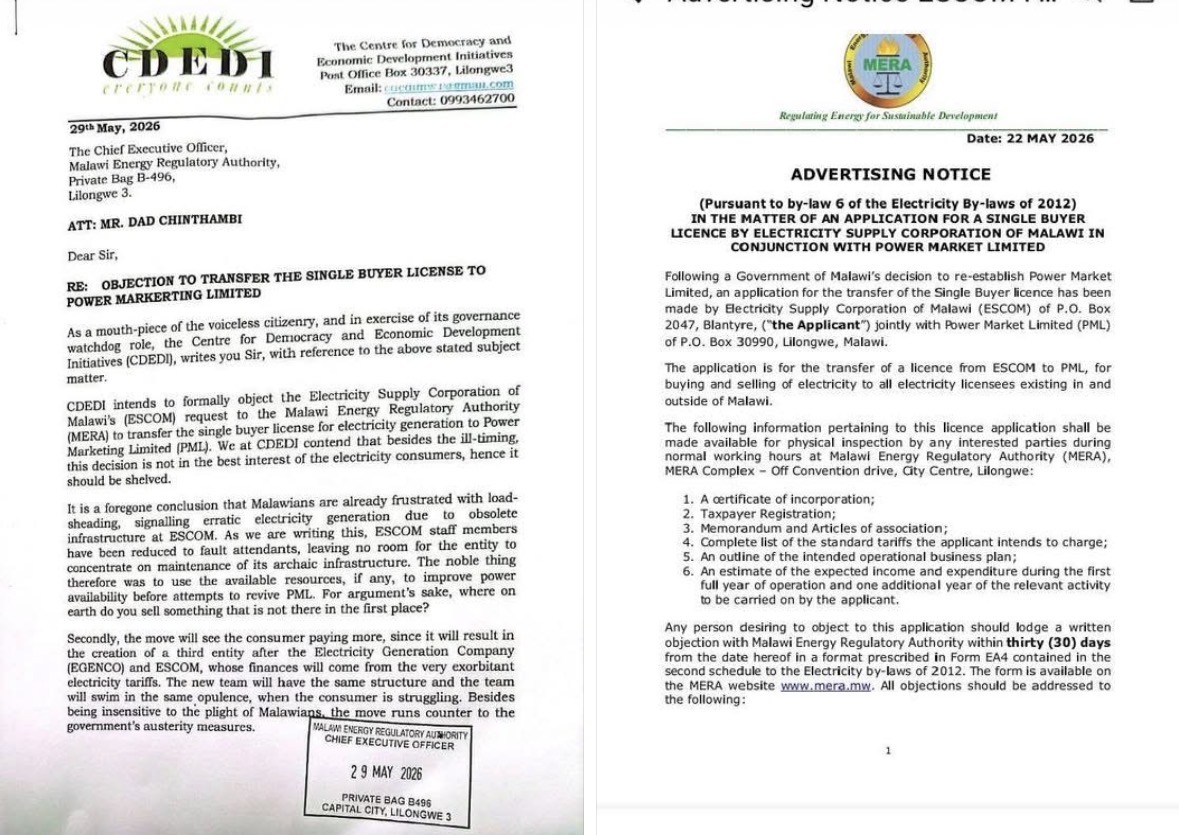
The Malawi Government’s proposal to transfer the Single Buyer Licence from the Electricity Supply Corporation of Malawi (ESCOM) to the newly revived Power Market Limited (PML) has sparked concern among consumer rights advocates and energy sector observers.
At a time when Malawians are grappling with persistent blackouts, unreliable power supply, and rising living costs, many are questioning whether creating another state-linked power entity is the right priority.
The Centre for Democracy and Economic Development Initiatives (CDEDI) has formally objected to the proposed transfer, arguing that the move is ill-timed and not in the best interests of electricity consumers. The organization contends that government should focus on fixing existing problems within ESCOM and the Electricity Generation Company (EGENCO) before introducing another institution into the already strained energy sector.The concerns raised are difficult to ignore.
Across the country, households and businesses continue to suffer from load-shedding and erratic electricity supply. Manufacturers lose productive hours, small businesses incur additional costs through the use of generators, and families are left in darkness for extended periods. In such an environment, consumers naturally expect government resources to be directed toward improving generation capacity, upgrading transmission infrastructure, and strengthening maintenance systems.
Instead, the proposed arrangement would introduce a third player into the electricity value chain.
Critics argue that establishing and operating PML will require additional administrative structures, management teams, office space, vehicles, allowances, and operational budgets. Ultimately, these costs have to be met from somewhere. The fear among consumers is that the financial burden could eventually be passed on to electricity users through higher tariffs.
Many Malawians are therefore asking a simple question: What value will PML add that ESCOM and EGENCO cannot provide under the current framework?
If the new company cannot guarantee more electricity generation, reduce blackouts, lower tariffs, or improve efficiency, then its creation risks being viewed as an unnecessary expansion of bureaucracy rather than a solution to the country’s energy challenges.
The timing of the proposal has also raised eyebrows. Government has repeatedly emphasized austerity measures and prudent management of public resources. Against that backdrop, creating another public entity appears contradictory to the message of cost-cutting and fiscal discipline.
Consumers are not demanding new company names or additional corporate structures. They want reliable electricity. They want fewer blackouts. They want affordable tariffs. They want investments that directly improve power generation and distribution.
Until government clearly demonstrates how Power Market Limited will deliver these outcomes, skepticism will remain.
For many citizens, the priority is straightforward: fix ESCOM, strengthen EGENCO, increase power generation, and end the blackouts. Anything short of that may be viewed as another costly experiment financed by taxpayers and electricity consumers who are already carrying a heavy burden.
The real question is not whether Malawi needs another power company. The real question is whether Malawians will receive better and more affordable electricity as a result of it.
About the Author