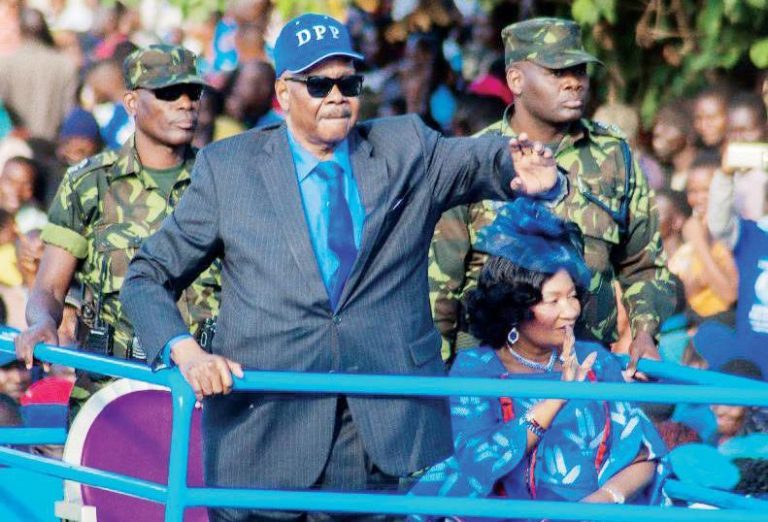
The ruling Democratic Progressive Party at its campaign launch at Njamba Freedom Park in Blantyre on August 3, 2025, President Peter Mutharika invoked his previous administration’s record to assure supporters that his government knew what it was doing.
“We will deliver on our promises. We have done this before and we will do it again. In 2014, we promised forex and we delivered,” he said.
Cables , you see ! The DPP before it bounced back into power ; it had all the solutions for the problems that Malawians were facing under the leadership of clueless former President Lazarus Chakwera and a bunch of his MCP zealots .
Now that they are in power . They are giving excuses and wanting patience from Malawians . A great reversal and controversy from their own campaign promises from which Malawians voted them into power .
They touted their campaign message , a return to proven leadership.
But now a year into their tenure,there is an uncomfortable contradiction in the Democratic Progressive Party’s (DPP) changing message on Malawi’s economic crisis: the party that campaigned on having the answers is now asking Malawians to give it two years to deliver them.
During the 2025 election campaign, DPP did not tell voters that fixing the economy would take two years.
It presented itself as a party with the experience, expertise and political will to turn around the country’s economic fortunes.
Foreign exchange shortages, fuel scarcity, hunger and rising prices were among the biggest issues the party used to make its case for a return to power. Its message was clear: it had done it before and could do it again.
But one year into government, that confidence appears to have given way to a different narrative that the problems are structural, inherited and cannot be resolved overnight.
Information and Communications Technology Minister Shadric Namalomba recently told Nation Online that the fuel and forex crises were inherited from the previous Malawi Congress Party (MCP) administration and would require time to resolve.
“The issue of forex was there. It is not something that has come about in the one year that DPP has been in government. The issue of fuel has been there,” he said.
That explanation may have merit. Governments inherit economic problems, and no reasonable person expects an administration to fix every structural weakness overnight.
However, the question DPP must answer is why the party appeared so certain about delivering solutions when it was seeking votes, only to emphasise the complexity of those same problems after winning power.
In Mzuzu, a week later after it launched its campaign on 3 August 2025, during a campaign rally at Katoto Ground in Mzuzu, Mutharika was even more emphatic about his priorities.
“The first thing is that we will make sure we have forex, then we will look at huge debt that the country has,” he told supporters.
His running mate, Jane Ansah, was equally confident.
In Mulanje on August 16, Vice President Jane Ansah assured voters that a DPP government would tackle hunger, fuel shortages and foreign exchange scarcity.
She also promised that ADMARC and the National Food Reserve Agency would always maintain maize stocks of at least 150,000 tonnes under a DPP administration.
Other senior party officials reinforced the same message.
During a September 8 campaign tour in the Eastern Region, DPP vice-president for the region, Bright Msaka, portrayed Mutharika as a leader capable of addressing the economic hardships facing Malawians. He highlighted soaring prices, fuel shortages and food insecurity as evidence of the suffering people had endured under the previous administration.
On September 9, at a press briefing in Blantyre, Sameer Suleman challenged the government’s fuel procurement arrangements, particularly the Government-to-Government (G2G) arrangement.
“As I am speaking, people are in queues waiting to buy fuel. So, where is the fuel that the government said it had purchased under the G2G arrangement?” he asked.
Ben Phiri, another senior DPP official, promised economic reforms that would ensure the availability of fuel, fertiliser, passports and cement if the party returned to government.
Meanwhile, manifesto committee chairperson Collins Magalasi outlined how the proposed economic recovery would be financed. He said the party would mobilise domestic resources through improved revenue collection and boost productivity to increase exports and generate foreign exchange.
The DPP manifesto went even further, promising exchange-rate stabilisation within six months.
Among its proposed interventions were negotiations with the International Monetary Fund (IMF) for a new Extended Credit Facility programme and securing financial arrangements worth between US$1.5 billion and US$2 billion to strengthen the country’s foreign reserves.
These were not vague assurances that government would eventually study the economy. They were presented as concrete commitments with specific targets and proposed interventions.
Yet the message from government has now shifted.
Namalomba says the country must pursue austerity measures to conserve foreign exchange, promote value addition, expand mining and engage the IMF to restore the Extended Credit Facility.
He has also urged critics to give government space, saying Mutharika has indicated that economic stabilisation could take at least two years.
That is a significant departure from the confidence with which the party approached voters.
The issue is whether voters were given realistic expectations in the first place.
When DPP was in opposition, the country’s economic difficulties were presented as problems that could be addressed through better leadership and sound economic management. Its leaders criticised the previous administration, questioned its policies and offered what they described as practical alternatives.
Now in government, the same party is emphasising inherited challenges, structural weaknesses and the need for patience.
Malawians did not elect the DPP merely to explain why fuel and foreign exchange are difficult to find. They elected a party that campaigned on its ability to address those very problems.
About the Author