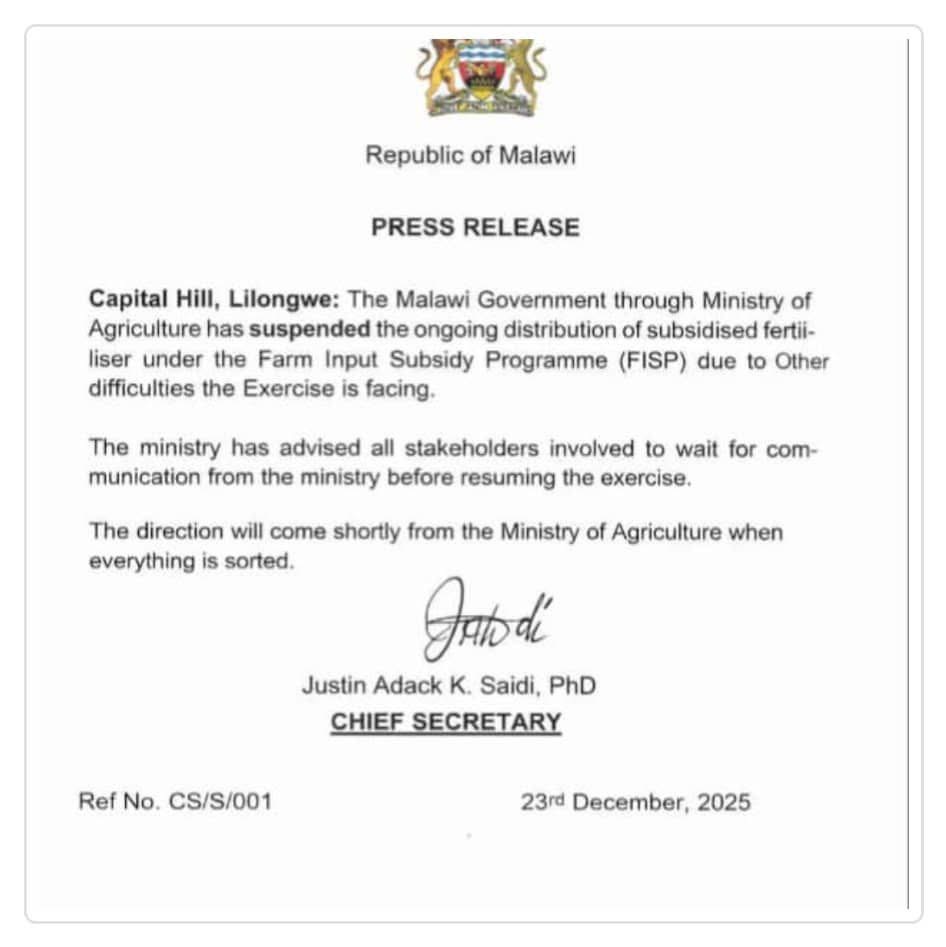
Stopping the Farm Input Subsidy Programme (FISP) at a time when maize is already at the fertilizer application stage is not just poor planning , it is gross negligence with devastating national consequences.
This FISP is one reason Malawians voted Arthur Peter Mutharika back .Mismanaging FISP is messing with Mutharika’ legacy, a betrayal to Malawians and politically suicide to the DPP government .
Maize does not wait for government circulars. The fertilizer stage is time-sensitive; missing it guarantees low yields or total crop failure.
Suspending FISP now means condemning millions of smallholder farmers to losses they cannot recover from, despite having already invested labour, seed, and land in good faith.
If government systems were unprepared, that failure should never be transferred to farmers. When inputs arrive late or distribution is halted mid-season, the message sent is clear: the state is either unable or unwilling to serve its people. At best, this reflects institutional incompetence. At worst, it borders on economic sabotage.
Food security is not an abstract policy issue — it is a matter of national survival. Malawi’s economy, nutrition levels, and social stability depend on maize. Disrupting fertilizer access at this critical stage is effectively manufacturing hunger, inflation, and unrest months in advance.
Calling this a “temporary suspension” does not reduce the damage. Agriculture operates on biological deadlines, not bureaucratic timelines. Every day lost now cannot be recovered later.
This is why the decision is a time-ticking bomb:
• It guarantees reduced harvests
• It increases food prices
• It deepens poverty
• It erodes public trust in government
Any government serious about serving Malawians would treat FISP as an emergency national priority, not an optional administrative exercise that can be paused without consequence.
If this is not deliberate sabotage, then it is a clear admission that the system is not ready, not responsive, and not centered on the lives of ordinary Malawians.
Malawi cannot afford policy paralysis when the fields are already planted and the clock is already running.
About The Author