While ordinary Malawians continue to face prolonged delays in obtaining passports, with some applicants reportedly waiting for years amid persistent shortages of passport books.
Cables can confidently reveal of a passport processing operation at the Lilongwe Immigration Offices, where foreign nationals are paying as low as MK500,000 and above to obtain Malawian passports.
Information obtained by Cables indicates that a network of immigration officials, working in collaboration with individuals within the National Registration Bureau (NRB), is facilitating the processing and issuance of Malawian passports to foreign nationals who are not legally entitled to hold them.
Our investigations have found out that nationals from Burundi, Rwanda, Nigeria and Tanzania are top in the list among those benefiting from the arrangement.
The practice point to a suspected scheme involving the change of personal identities, whereby foreign nationals are assisted in acquiring Malawian names and identity records to enable them to apply for passports as Malawian citizens.
A TANZANIAN NATIONAL BECOMES ALICE BANDA
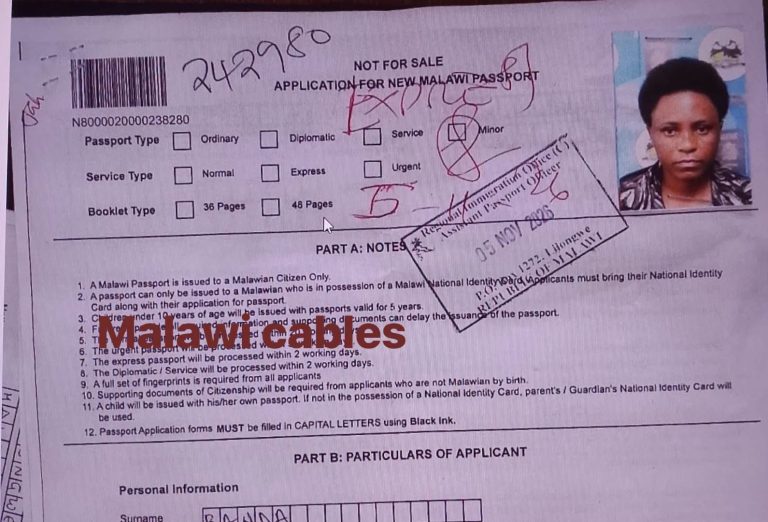
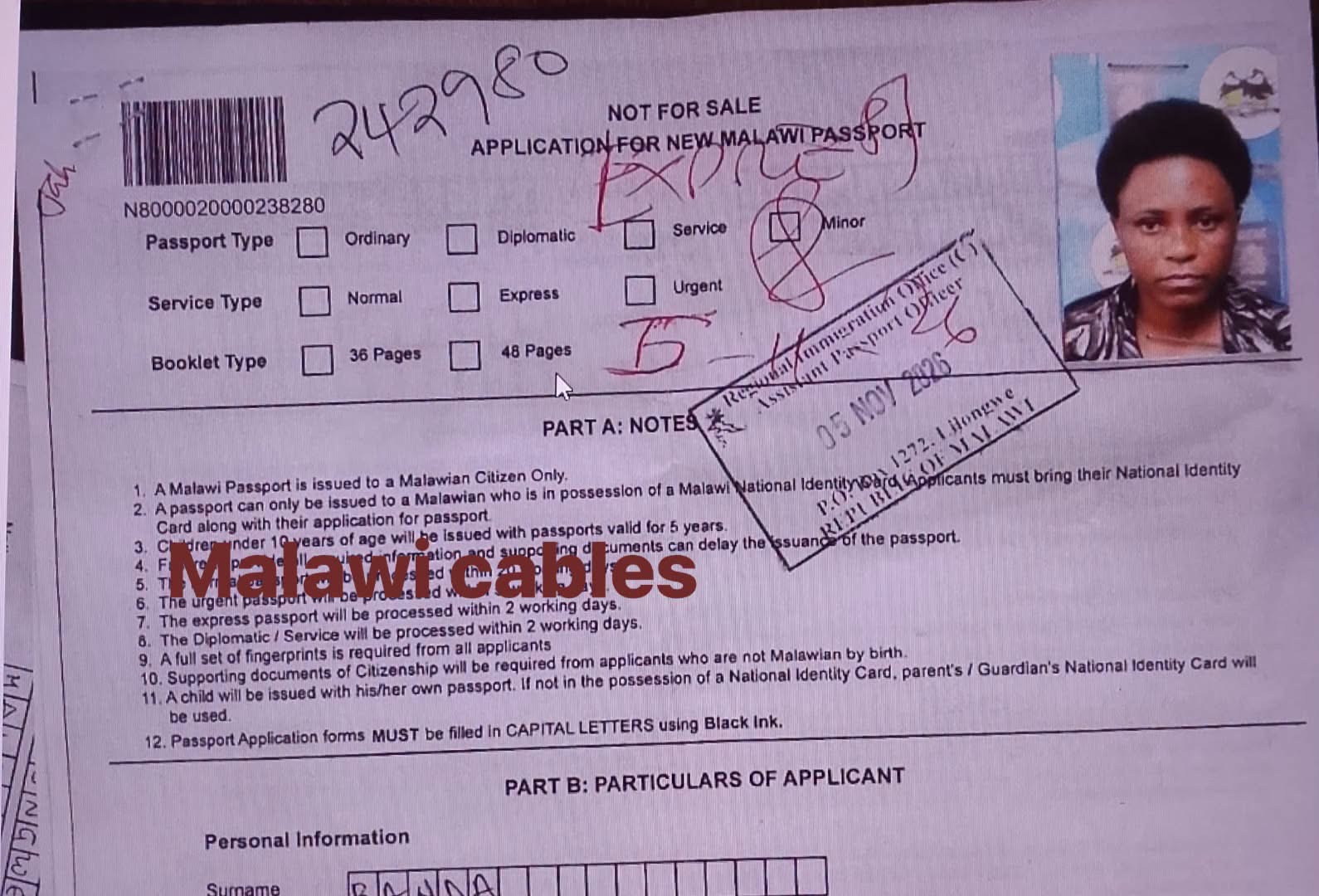
One of the cases that has come to Cables’ attention involves a Tanzanian woman whose passport application was processed on 5 November 2026.
Records in our possession identify the woman as a Tanzanian national who has not been naturalised as a Malawian citizen.
However, immigration records show that she was issued a Malawian passport under the name Alice Banda, with an address recorded as Area 47, Chigoneka, in Lilongwe.
More concerning, the application reportedly identifies her as a Malawian citizen by birth, despite information obtained by Cables indicating that she is Tanzanian.
Cables has also established that the application lists her date of birth as 14 July 1997.
However, checks conducted against birth records at Bwaila Hospital, popularly known as Bottom Hospital, in Lilongwe, found no corresponding birth record for a person named Alice Banda matching the details provided.
AREA 47 RESIDENTS QUESTION HER IDENTITY
In an effort to establish the woman’s background, Cables spoke to residents in Area 47, Chigoneka, where the passport application indicates she resides.
Several residents expressed shock upon being informed that the woman was officially recorded as Alice Banda, a Malawian citizen.
One resident, who spoke to Cables on condition of anonymity, said:
“We know this woman as a Tanzanian. We live with her in the hood, and it is news to hear that you are telling us she is a Malawian by the name Alice Banda and by birth .”
ONE DAY FOR A FOREIGNER, YEARS OF WAITING FOR MALAWIANS
Perhaps the most disturbing aspect of this case is the reported speed at which the passport was processed.
While thousands of Malawians continue to struggle to access passport services, the Tanzanian woman obtained her Malawian passport on the very day she submitted her application on 5 November 2026.
This happened barely days after frustrated Malawians staged demonstrations at the Lilongwe Immigration Offices over delays and the unavailability of passport books.
For ordinary citizens, the explanation has repeatedly been that passport books are unavailable and that printing services cannot meet demand.
Yet, if the information contained in the records obtained by Cables is accurate, a foreign national was able to navigate the same system and obtain a passport within hours.
WHO IS SELLING MALAWI’S NATIONAL IDENTITY?
How does a foreign national acquire Malawian identity records without having undergone the legally required naturalisation process?
Who authorised the change of identity and the use of a Malawian name?
How was an application declaring the woman Malawian by birth processed despite information suggesting that she was born in Tanzania?
Who facilitated the processing and issuance of the passport within a single day?
And, most importantly, are passport books genuinely unavailable to ordinary Malawians, or are some applicants receiving preferential treatment through an underground network?
Cables is calling on the Department of Immigration and Citizenship Services, the National Registration Bureau, the Ministry of Homeland Security and relevant investigative authorities to urgently investigate this case , establish how the passport was issued and identify everyone who may have facilitated the transaction.
Malawi’s passport is a sovereign national document. Its issuance must be governed by the law, not money, personal connections or corrupt arrangements.
Cables will continue pursuing this investigation.
About the Author