Screenshot
Between 2020 and September 2025, the Malawi Congress Party (MCP)–led government awarded several multimillion-kwacha contracts to senior party officials and politically connected individuals. During this period, despite public complaints and allegations of corruption—including reported losses involving fertilizer procurement, fuel supply, and foreign-exchange deals—there was limited public response from key civil society organisations (CSOs).
No major statements or sustained advocacy efforts were seen from bodies such as the Human Rights Defenders Coalition (HRDC), even as significant public funds were allegedly lost.
This perceived silence raised questions among citizens about consistency and impartiality in governance and accountability advocacy.
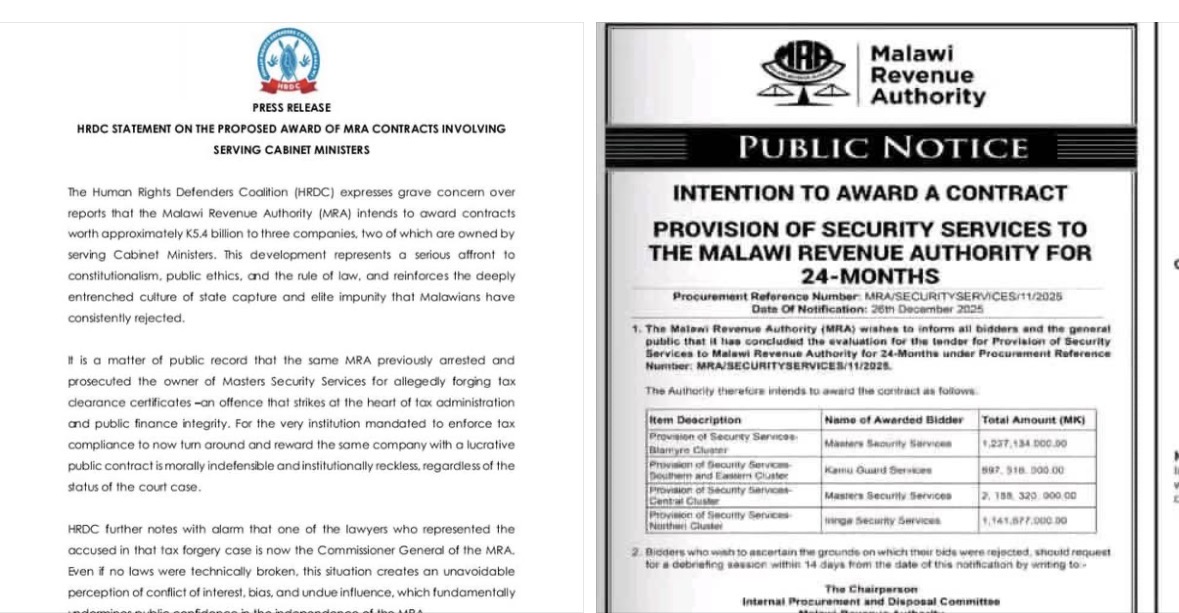
More recently, governance and human-rights organisations have expressed concern over the Malawi Revenue Authority’s (MRA) intention to award security contracts worth approximately K5.4 billion to three companies, including Masters Security Services and Iringa Security Services, both reportedly linked to serving Cabinet ministers.
HRDC has warned that the proposed contracts raise serious conflict-of-interest concerns. It noted that MRA had previously prosecuted Masters Security Services for allegedly forging tax-clearance certificates, arguing that awarding such a lucrative contract to the same company could undermine public confidence in public institutions.
Similarly, the Centre for Social Accountability and Transparency (CSAT) described the decision as troubling, particularly at a time when Malawi is facing acute fiscal constraints. CSAT’s executive director, Willy Kambwandira, emphasised the need for higher standards of transparency and prudence in public spending.
Both HRDC and CSAT have called for the suspension of the procurement process, full disclosure of company ownership and evaluation criteria, and independent parliamentary oversight to ensure accountability and transparency.
While MRA has issued a public notice indicating its intent to award the contracts, it has yet to publicly respond to the concerns raised by civil society organisations.
About the Author