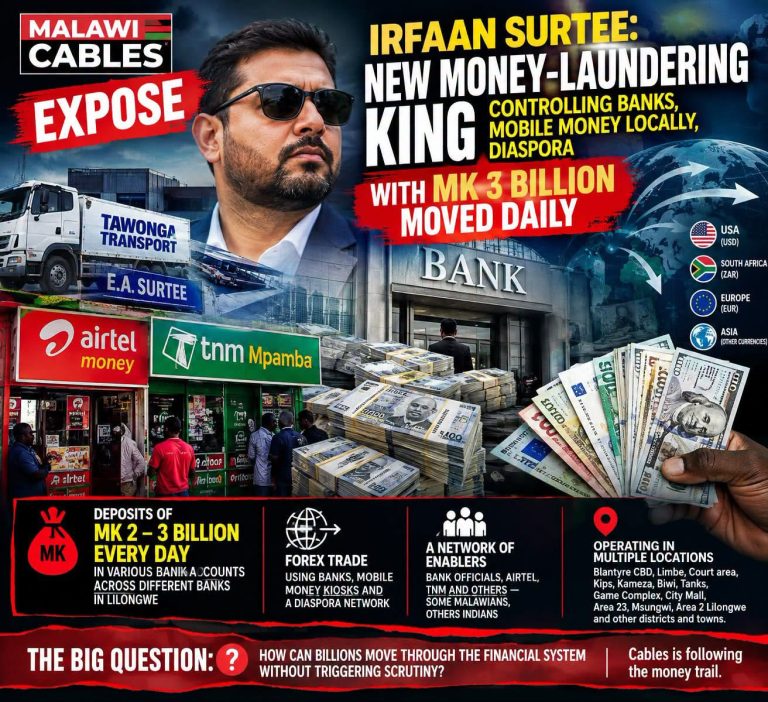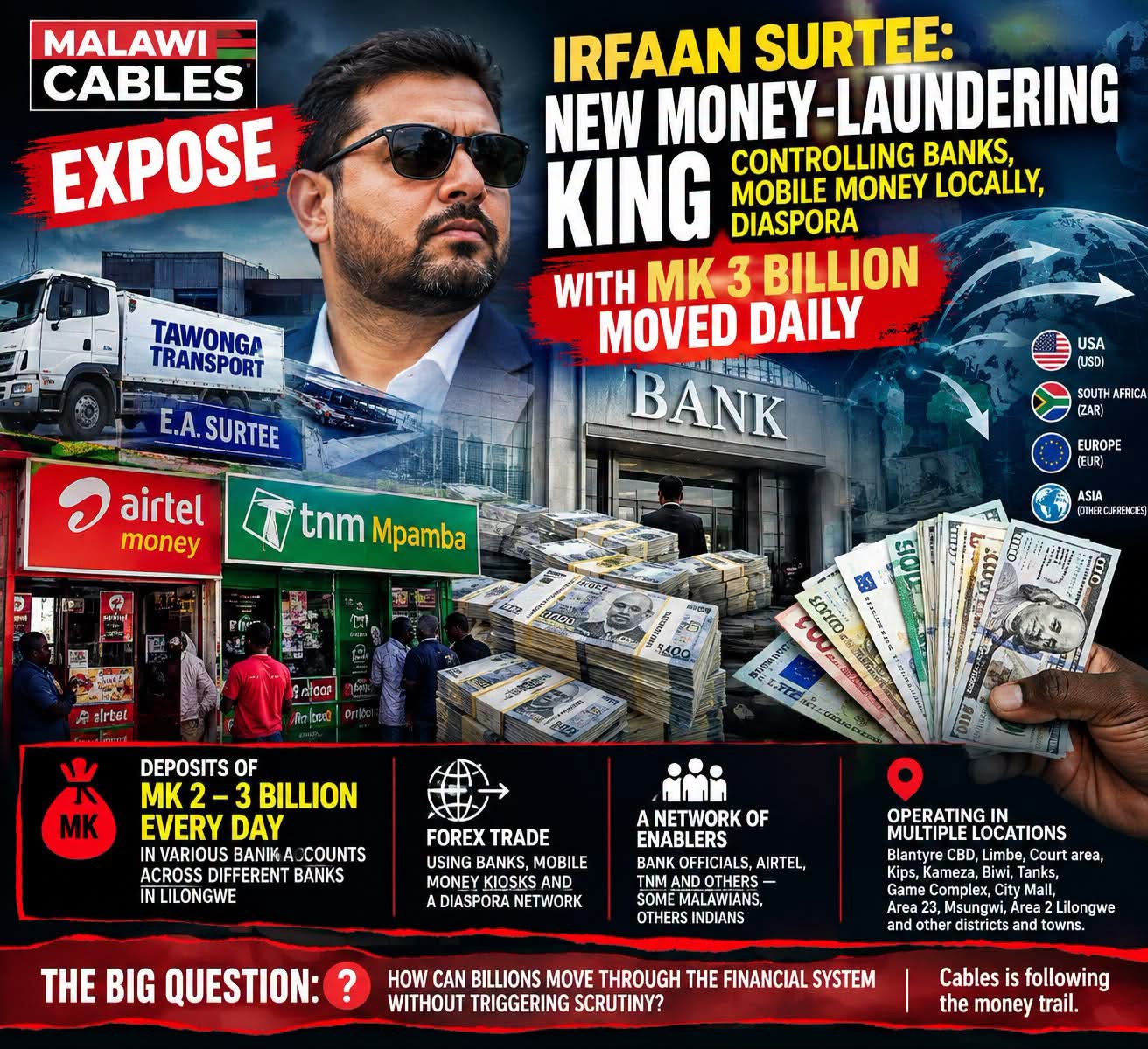
Cables has uncovered what appears to be a sophisticated money-moving network linked to businessman Irfaan Surtee, involving forex trading, bank accounts, mobile-money agents and transactions between Malawi and the diaspora.
According to information obtained by the Cables investigative desk, Surtee is playing a significant role in Malawi’s informal forex market, with a network reportedly extending from Malawi to Malawians living abroad.
Our money trail indicates that Surtee has been spending extensive periods at banks in Lilongwe, where he is making substantial deposits ranging between MK2 billion and MK3 billion per day through various accounts across different banks.
Cables has also established that Surtee operates businesses known as Tawonga Transport and E.A. Surtee, with the transport business being used as part of a wider network through which money is moved and converted.
According to information available to Cables, individuals linked to the network operate Airtel Money and TNM Mpamba kiosks in several strategic locations, including parts of Blantyre, Limbe, the Court area, Kips, Kameza, Biwi, Tank, Game Complex, City Mall, Area 23, Msungwi and Area 2 in Lilongwe.
The network is also reportedly extending into other districts and towns, where additional individuals have been incorporated as mobile-money agents.
Cables has it on authority that some individuals within banking and telecommunications circles may be facilitating the movement of funds.
These individuals are people associated with banks, Airtel and TNM mobile banking services .
According to cables inside the syndicate, the system works by connecting people in Malawi who need local currency with individuals in the diaspora who can make payments in foreign currency and they need the local currency.
For example, a Malawian in the United States seeking to send money to Malawi may be provided with a US-dollar bank account into which the money is deposited.
Those sending money from South Africa may be given a South African bank account, while people in Europe may be provided with euro-denominated accounts.
Similar arrangements are made for people operating in other parts of the world.
The foreign accounts used belong to individuals linked to Surtee and his associates rather than necessarily to the person receiving the money in Malawi.
Once a deposit is made abroad, the equivalent amount in Malawi kwacha is released locally through bank accounts or, in some cases, through Airtel Money or TNM Mpamba agents.
The arrangement would effectively allow money to move between Malawi and other countries without necessarily passing through conventional formal foreign-exchange channels.
Cables understands that the system requires significant amounts of liquidity in Malawi to meet demand from people seeking foreign currency.
This, according to our sources, is why Surtee is making extremely large daily deposits, reportedly reaching MK2 billion to MK3 billion.
The Irfaan Surtee money laundering network comes at a time when Malawi continues to face severe foreign-exchange shortages, with businesses and individuals struggling to access US dollars and other major currencies through formal channels.
The growing gap between official and black-market exchange rates has created an environment in which informal forex networks can potentially generate substantial profits.
Cables understands that the activities are not limited to Lilongwe and Blantyre, with the network reportedly extending to other districts through mobile-money agents and other
Cables has also received information that certain officials may be aware of the network and that some individuals could be benefiting from it and there is nothing those in authority can do to stop this as they are the major beneficiaries by extension.
The development is pointing to a much wider system of parallel foreign-exchange trading that is contributing to Malawi’s forex crisis while ordinary citizens and legitimate businesses continue to bear the consequences.
About the Author